Skin Education
Home Skincare
Common Skincare Mistakes That Might Be Hurting Your Skin
A good skincare routine should help your skin feel more balanced, comfortable, and supported. But sometimes the products and habits intended to improve your skin can actually contribute to dryness, irritation, congestion, sensitivity, or an impaired skin barrier.
Home Skincare · 10 min read

Skincare has become increasingly complicated. Between cleansers, toners, exfoliants, serums, retinoids, moisturizers, masks, acids, oils, and trending ingredients, it can be tempting to believe that a more complicated routine will automatically produce better skin.
That is not always the case. Skin responds to the entire routine rather than one individual product. Even excellent skincare products can become problematic when they are used too frequently, combined incorrectly, or chosen without considering your individual skin type and condition.
Here are some of the most common skincare mistakes — and why simplifying or adjusting your routine may sometimes produce better results.
Mistake #1: Cleansing Too Frequently or Too Aggressively
Cleansing removes makeup, sunscreen, oil, environmental debris, and other substances from the skin. However, excessive cleansing or harsh cleansers may remove too much of the skin's natural lipids — the protective layer that helps keep moisture in and irritants out.
When cleansing becomes too aggressive, you may notice signs such as:
- •Tightness after cleansing that persists beyond a few minutes
- •Dryness or flaking even when using moisturizer
- •Increased sensitivity to products that previously felt comfortable
- •Redness or visible irritation around the nose, cheeks, or forehead
- •Stinging or burning when applying serums, treatments, or even moisturizer
Your skin should generally feel clean after cleansing but not stripped or excessively tight. If it consistently feels uncomfortable immediately after washing, your cleansing approach may deserve another look.
Mistake #2: Using Too Many Active Ingredients at Once
Active ingredients can transform a skincare routine when they are selected and used appropriately. Retinoids for texture and aging. AHAs for exfoliation. Vitamin C for brightness. Benzoyl peroxide for acne. Niacinamide for barrier support and pigmentation.
But stacking multiple strong active products without considering frequency and compatibility can increase irritation, compromise the skin barrier, and create confusion about which product is actually helping or causing problems.
Introducing one new active ingredient at a time and allowing several weeks between additions can make it easier to determine how your skin responds before complicating the routine further.
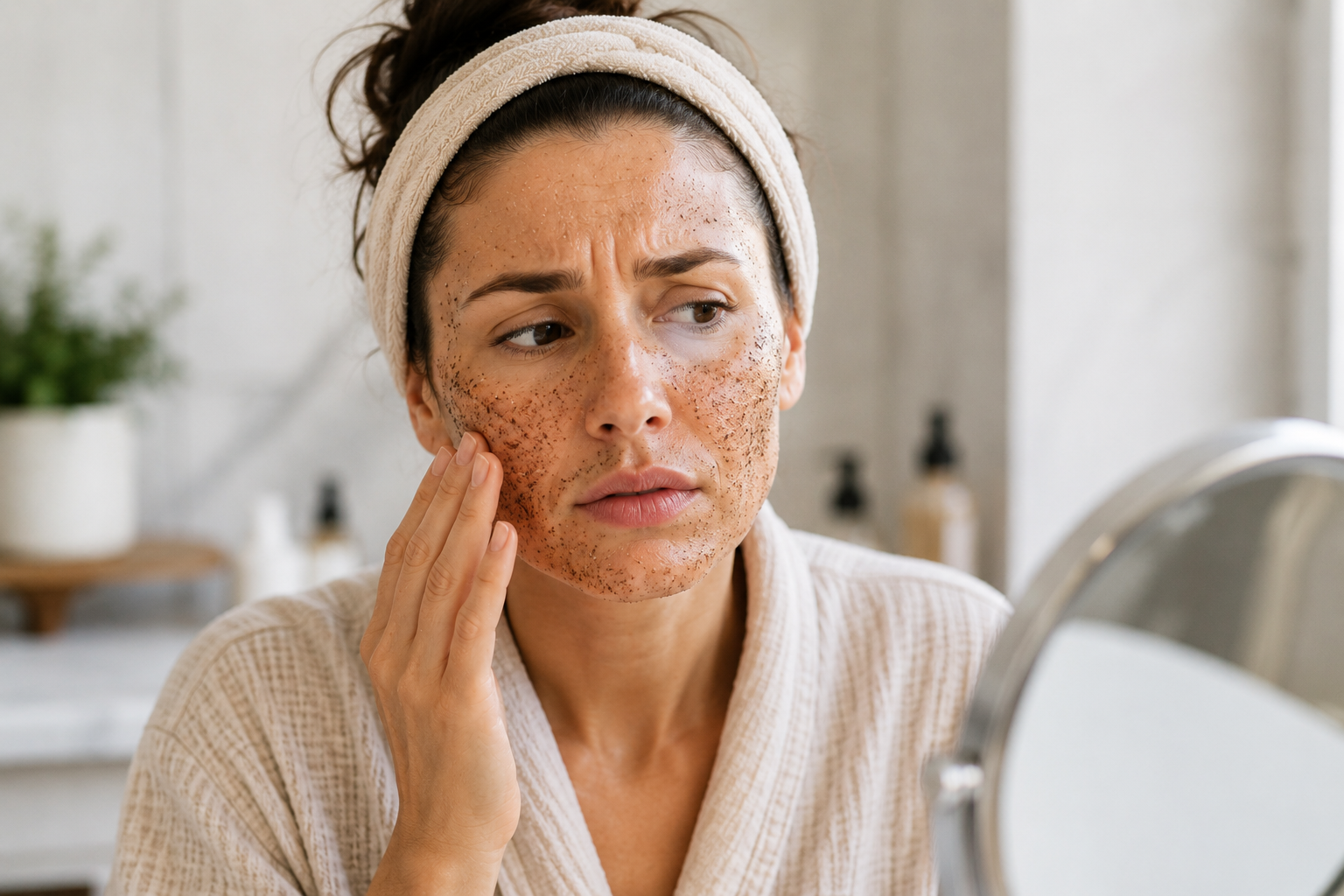
Mistake #3: Exfoliating Too Often
Exfoliation can improve the appearance of surface texture, remove accumulated dead skin cells, and help other products absorb more effectively. But more exfoliation does not necessarily produce smoother skin.
Too much exfoliation may contribute to sensitivity, redness, dryness, tightness, flaking, burning or stinging, increased reactivity, and a cycle where the skin feels rougher so you exfoliate more — making the problem worse.
If this sounds familiar, you may want to read more about over-exfoliation and how to find the right balance for your skin.
Mistake #4: Layering Products Without Considering Order
Skincare layering can affect how products feel on the skin and how effectively they function. While there is no single correct routine for everyone, a simple general framework can help ensure each product has an opportunity to work:
- •Cleanse — remove makeup, sunscreen, and debris
- •Lightweight treatment products (toners, essences)
- •Serums and targeted treatments
- •Moisturizer
- •Sunscreen during the daytime (final step before makeup)
Exact routines vary depending on the products being used, your skin type, and the time of day. For a deeper look at building an effective layered routine, explore our guide on proper product sequencing.
Mistake #5: Changing Products Too Quickly
It is tempting to abandon a product after several days because you do not see immediate changes. But many skincare products require consistent use over weeks or even months before their full benefits become visible.
Frequently replacing products also makes it difficult to determine which products are helping or causing irritation. You may end up cycling through dozens of products without ever giving any of them a real chance to work.
Certain reactions — such as significant irritation, allergic response, or persistent breakouts — do warrant stopping a product. But simply not seeing immediate cosmetic improvement does not necessarily mean a product is ineffective.
Mistake #6: Skipping Moisturizer Because Your Skin Is Oily
Oil production and hydration are not the same thing. Oily skin produces excess sebum, while dehydration refers to a lack of water in the skin. It is entirely possible — and quite common — for skin to be both oily and dehydrated at the same time.
Avoiding moisturizer entirely because your skin feels oily may leave you with skin that feels simultaneously uncomfortable, shiny, and tight underneath. The solution is not necessarily eliminating moisture support — it may be choosing a lighter, non-comedogenic formula that provides hydration without heaviness.
Mistake #7: Picking or Squeezing Blemishes
Picking at blemishes is one of the most common habits people struggle with, but it can significantly worsen the appearance and healing timeline of a breakout.
Picking increases inflammation and trauma to the skin. This can lead to prolonged redness, post-inflammatory hyperpigmentation, visible marks that last longer than the original blemish would have, delayed healing, and in some cases, increased risk of scarring or infection.
Allowing blemishes to heal without interference and seeking professional guidance when acne or congestion becomes persistent generally produces better long-term results than picking.
Mistake #8: Ignoring Your Neck and Chest
Skincare routines frequently stop at the jawline, yet the neck and upper chest experience much of the same environmental exposure as the face — UV radiation, pollution, temperature changes, and the natural aging process.
Extending appropriate skincare and daily sunscreen to these areas can help maintain more consistent skin quality between your face, neck, and chest over time.
Mistake #9: Forgetting to Clean Makeup Brushes and Tools
Brushes, applicators, reusable tools, and other items that regularly contact your face can accumulate product residue, oil, debris, and microorganisms over time. Using dirty tools repeatedly can transfer bacteria back to your skin and potentially contribute to congestion, breakouts, or irritation.
Regular cleaning according to manufacturer recommendations, frequently changing pillowcases, and avoiding unnecessary touching of the face throughout the day can all help reduce unnecessary contact with potential irritants.
Mistake #10: Choosing Products Based Only on Trends
Viral skincare products and trending routines are designed for broad audiences. A product that works exceptionally well for one person may not be appropriate for another person's skin type, sensitivity, acne tendency, pigmentation concerns, existing routine, or treatment history.
Trend-driven purchasing can also lead to accumulating multiple products that overlap in function, conflict with each other, or simply do not address your actual skin concerns. Individualized skincare based on your specific skin generally produces better results than chasing whatever is currently popular online.
Mistake #11: Skipping Daily Sunscreen
Sunscreen should not be reserved only for beach days or summer vacations. Daily ultraviolet exposure during ordinary activities — driving, walking outside, sitting near windows, exercising outdoors — contributes to visible skin aging, uneven pigmentation, changes in texture, and cumulative sun damage over time.
Making broad-spectrum SPF part of your consistent morning routine is one of the most effective long-term investments you can make in your skin's health and appearance.
Signs Your Skincare Routine May Be Working Against You
Skin often provides clues when something in a routine needs adjustment. Possible signs include:
- •Persistent tightness that does not improve with moisturizing
- •Unexpected flaking or peeling
- •Increased redness that was not present before
- •Burning or stinging when applying products that previously felt comfortable
- •Sudden sensitivity or reactivity
- •New or worsening congestion
- •Unusual dryness despite using moisturizer
- •Oiliness combined with dehydration or tightness
- •Products beginning to sting when they did not before
These symptoms can have multiple causes and should not automatically be blamed on a single product. Sometimes the most productive step is simplifying the routine, giving the skin time to settle, and evaluating what your skin actually needs before adding additional products.
Jordan's Take
"One of the biggest things I notice is that people often assume they need more skincare when their skin starts acting differently. So they add another serum, another exfoliant, or another treatment product — and sometimes that makes the situation even more confusing. I like to look at the entire routine first. What are you using, how often are you using it, and how is your skin responding? Sometimes the smartest change we can make is taking something away rather than adding something new."
When Professional Skin Guidance Can Help
It can be difficult to objectively evaluate your own skincare routine, particularly when several active ingredients are being used, products were purchased at different times, or you have been following advice from multiple sources online.
A professional skin assessment can help evaluate your current skin condition, existing skincare products, ingredient overlap, exfoliation frequency, hydration and barrier support, and individual aesthetic concerns as a whole rather than addressing one symptom at a time.
At Jordan Skin Studio in Frisco, Texas, skincare recommendations are customized according to the individual rather than built around a one-size-fits-all protocol. Jordan can review the products you are currently using, discuss your skin concerns, and help identify where your routine may benefit from simplifying, adjusting, or adding targeted support. Recommendations may include home skincare changes and/or professional treatments depending on the individual.
Frequently Asked Questions
Continue Learning
Exfoliation
Over-Exfoliation: When Less Is More
Why stripping your skin barrier might be causing more problems than it solves.
Read Article →
Hydration
Dehydrated vs. Dry Skin: Understanding the Difference
These terms describe completely different skin conditions requiring different approaches.
Read Article →
Home Skincare
Skincare Layering Done Right
The correct order for applying your products — and why sequence matters.
Read Article →Not sure what your skin needs?
Start with a conversation. Jordan can help evaluate your current routine, skin concerns, and goals and determine an approach that makes sense for your skin.
Get Started